Showing posts with label Environment and living. Show all posts
Showing posts with label Environment and living. Show all posts
Tuesday, September 7, 2010
Monday, March 1, 2010
PALMISTRY for beginners
Predicting the future has been the most coveted things since the beginning of mankind. The first tool , to actually do it , came from INDIA. Yes, Maharishi Parashar was the founder of vedic astrology. According to the legend, maharishi has said that whoever of his sons(means a brahmin) studies his work, he would always have wealth showered on him. Even today astrology has become a huge area of interest in India as well as other parts of the world. But I have observed one big limitation of the study i.e its extreme dependence on the authenticity of the birth time of the person. Even few minutes of error can make the kundali look foolish.
Hence another tool i.e palmistry comes to our rescue. As it is the study of our palms, no question of error arises in it. But still the degree of resolution upto which we can predict is limited in palmistry compared to astrology. One thing more, many people think that whatever palmistry predicts, becomes your future. Actually i have observed through the years that it is not completely true. The karma of the person is also very important. Palmistry predicts while incorporating some bit of error inherently as well as depending on the expertise of palmist. Always remember that our future is in our hands and we are not in hands of our future.
Starting with the basic palmistry, we study 4 basic things :The lines, the mounts,The signs,The shapes.

1. The three lines found on almost all hands, and generally given most weight by palmists:
The heart line is the first of the major lines examined by a reader. It is found towards the top of the palm, under the fingers. Palmists interpret this line to represent matters of the heart, and believe it can indicate emotional stability, romantic perspectives, depression, and stoicism, in addition to various aspects of cardiac health.
The next line identified by palmists is the head line. This line starts at the edge of the palm under the index finger and flows across the palm towards the outside edge. Palmists generally interpret this line to represent the person's mind and the way it works, including learning style, communication style, intellectualism, and thirst for knowledge.
Finally, readers look at perhaps the most controversial line on the hand, the life line. This line extends from the edge of the palm above the thumb and travels in an arc towards the wrist. This line is believed to represent the person's vitality and vigor, physical health and general well being. The life line is also believed to reflect major life changes, including cataclysmic events, physical injuries, and relocations.
Another important line, the fate line runs from the bottom of the palm near the wrist, up through the center of the palm towards the middle finger. This line is believed to be tied to the person's life path, including school and career choices, successes and obstacles. Sometimes this line is thought to reflect circumstances beyond the individual's control, or alternately the person's choices and their consequences.
2. THE MOUNTS are associated with the Planets and the Days of the Week.
Each finger is associated with a planet. At the base of each finger is the mount, a raised pad of flesh, associated with the sign of the finger.
The INDEX FINGER (Mount of Jupiter). A long index finger shows a boss, commander, a leader, someone who has pride, confidence, and much ambition. The index finger shows the degree of self-confidence, so from its size and shape can be judged things like leadership, ability or shyness, bossiness or timidity.
The MIDDLE FINGER: (Mount of Saturn) A long middle finger indicates wisdom, independence, solitude, experience, shyness, and melancholy. The middle finger reveals the serious side of a personality. How it is developed reveals reliability, talent, responsibility or frivolity (depending upon the size).
The THIRD FINGER: (Mount of Apollo) A long third finger shows the love of beauty. The Ring finger is a symbol of creativity and artistic qualities. A strong development goes with a talent for art, music, visual art, etc.
The PINKIE FINGER: (Mount of Mercury) A long pinkie finger shows a sharp, quick, clever, shrewd mind. A person with this, is found to be friendly, good with people skills, and outgoing. The little finger represents sex and communication. All sorts of sexual and romantic qualities are shown here, as well as the ability to speak, write or express oneself.
The Mount of Venus:The thumb and the base of the thumb comprise the Mount of Venus. This Mount comments on emotional and erotic drive & shows warmth, kindness and affection which are in the persons attributes.If the Mount is full, firm, and round: this person proves to be a great friend, great lover, and full of kindness. If the Mount of Venus is thin, dry and leathery:this is a person who is cold and shallow. This person tolerates very little. Often the Mount of Venus is patterned by many vertical and horizontal lines: This person hides feelings very well. On the surface everything seems fine, but underneath, there are many emotions that run deep.
The lower Mount of Mars:
Between the he thumb and the Index finger is the lower Mount of Mars above the Mount of Venus. If normal shows perseverance ,If the Mount is full, firm, and round, this person is fearless and arrogant, . If it is very flat that points to hesitancy or cowardice.
The upper Mount of Mars:
Beneath the Mount of Mercury above the Mount of the Moon; concerns moral attitude. If normal shows pragmatic well balanced character.. If the Mount is very prominent it indicates a potential for cruelty. . If it is very flat that indicates a weak resolve and people who shift for convenience.
The Mount of the Moon:
Below the pinkie finger and the upper Mount of Mars near the wrist is the Mount of the Moon.
It reflects intuition & creativity. If normal indicates a healthy fantasy life. If the Mount is full, firm, and full it indicates difficulty separating truth from fiction. If it is very flat that points to lack of imagination.
3. The signs
Depending on the area or mound they are found different marks show certain effects in that area. Here are just a few.
X Cross: Bad Luck (except when located between the Head and Heart Line.)
l Vertical line: talent & potential.
__ Horizontal line: diminishing returns.
/ Diagonal line: emphasizes a negative aspect.
* Star: good luck & success.
. Dots & blotches: obstacles.
Y Forks: split focus.
Circles: misfortune (except on the Mount of Apollo, great success is indicated.)
Square: protection & security.
Triangle: good luck & success.
Islands: stressful difficulties.
4. The shapes
The shapes do not form a great deal in original palmistry but still for enthusiastic readers here they are:
One can tell a lot about a person from the examination of a persons Hand.A person's personality is revealed in great detail! Because the persons nature and character are considered to be genetic, these inherited traits can be reflected in finger prints and the many patterns that are found in the palm.
CLASSIC HAND TYPES:
ELEMENTAL: Wide palm and short thick fingers and Thumb shows a steady, simple slow thinking non intellectual person who operate on instinct.
SQUARE: Square shaped palm and medium fingers shows a steady, calm practica nature, good business sense, who depend on outside guidence. person.
SPATULA: Tapered palm and fingers that broaden at the tipsis found on ambitious, energetic independent people.
KNOTTY: Wide palm and protruding knuckles are philosophical,with sensitivity and intellictual strength but shy & introverted.people.
CONE: Long palm and long tapered fingers people are artistic creative, outgoing, social & impulsive.
IDEALISTIC: Unusually long thin fingers are intuitive & psychic sometimes with a loose grip on reality.
MIXED: Most Hands are mixed, you then combine the characteristics.
NEXT comes examining the fingernails, ONYCHOMANCY , from onyx, meaning nail or Claw. Modern Hand reading sometimes skips this part.Basic Things:
Long: A tranquil nature, & artistic sensibilities.
Short: Energetic, with a tendency to be critical.
Very short: A quick temper, easily irritated.
Broad: Emphatically opinionated.
Tapering outward: Impressionable, overly concerned about others opinions.
Vertical Ridges: High strung, prone to agitation.
Horizontal Ridges: Evidence of recent trauma.
Deeply colored: Fairly robust and healthy.
White Spots: Exceptionally Lucky.
Well i hope that you have got a fair bit of idea about palmistry. There are little variants available in different parts of world but on the whole things remain almost the same. The expertise comes from practice and experience. And if you are still skeptical about palmistry, then please first try it and then form a judgment.
Tuesday, January 26, 2010
Square Foot Gardening – Grow Your Own Vegetables
The purpose of square foot gardening is to harvest the most produce possible from the space available, by growing small quantities over a longer time. This is also achieved by reducing the space between plants. To ensure you understand your garden and learn about plants you should keep a square foot garden diary to have a log of your failures and successes to improve your results.
The practice of square foot gardening is not just for those with small gardens; rather square footgardens allows you to concentrate your work effort to create an ideal plant environment, to give better natural yields.
The are many people who like the idea of digging for victory. They enjoy the sight of long, straight rows in their gardens and the hard labour that goes with digging and hoeing the land, whilst others like machine cultivation.
Owning a square foot garden still means weeding by hand but because the raised bed is filled with vermiculite, peat and compost there are fewer weeds and they can easily be seen and removed in a few minutes.
If you like the idea of all your vegetables being ready to harvest in one go then square foot gardens are not for you. The idea of square foot gardens is to have something growing all the time so you can have fresh vegetables growing in your garden for most of the year.
To benefit you need to have a good square foot garden plan which requires to be thought out early in the year, thorough planning to make the best use of your time and space. Before you start planting, you must consider the interrelationships of plants with each other and their needs and how to protect them from bugs and insects.
Square foot gardens are based on 4ft by 4ft raised beds. If you have more space then the length of the bed can be increased to 3.6m. The width should not be more that 1.2m so that you can easily reach the middle with out standing on the soil.
The practice of square foot gardening is not just for those with small gardens; rather square footgardens allows you to concentrate your work effort to create an ideal plant environment, to give better natural yields.
The are many people who like the idea of digging for victory. They enjoy the sight of long, straight rows in their gardens and the hard labour that goes with digging and hoeing the land, whilst others like machine cultivation.
Owning a square foot garden still means weeding by hand but because the raised bed is filled with vermiculite, peat and compost there are fewer weeds and they can easily be seen and removed in a few minutes.
If you like the idea of all your vegetables being ready to harvest in one go then square foot gardens are not for you. The idea of square foot gardens is to have something growing all the time so you can have fresh vegetables growing in your garden for most of the year.
To benefit you need to have a good square foot garden plan which requires to be thought out early in the year, thorough planning to make the best use of your time and space. Before you start planting, you must consider the interrelationships of plants with each other and their needs and how to protect them from bugs and insects.
Square foot gardens are based on 4ft by 4ft raised beds. If you have more space then the length of the bed can be increased to 3.6m. The width should not be more that 1.2m so that you can easily reach the middle with out standing on the soil.
Why hasn't Earth warmed as much as expected?
Earth has warmed much less than expected during the industrial era based on current best estimates of Earth's "climate sensitivity"—the amount of global temperature increase expected in response to a given rise in atmospheric concentrations of carbon dioxide.
In a study published online on Jan. 19 in the Journal of Climate, Stephen Schwartz of Brookhaven National Laboratory, Robert Charlson of the Univ. of Washington and colleagues examine the reasons for this discrepancy.
According to current best estimates of climate sensitivity, the amount of carbon dioxide and other heat-trapping gases added to Earth's atmosphere since humanity began burning fossil fuels on a significant scale during the industrial period would be expected to result in a mean global temperature rise of 3.8 degrees Fahrenheit. That is well more than the 1.4 degrees F. increase that has been observed for this time span.
"The data show that either we have 40 years of emissions left before the atmosphere can't absorb any more carbon dioxide, or we're already past the point of no return. In other words, the uncertainty rate is unacceptably high," said Charlson, a UW atmospheric sciences professor who in the 1960s invented a device called the integrating nephelometer to measure atmospheric haze particles, producing data that is still used in climate models today.
The new analysis attributes the reasons for the discrepancy between projected and actual temperature increase to a possible mix of two major factors: Earth's climate may be less sensitive to rising greenhouse gases than currently assumed and/or reflection of sunlight by haze particles in the atmosphere may be offsetting some of the expected warming.
"Because of present uncertainties in climate sensitivity and the enhanced reflectivity of haze particles," said Schwartz, "it is impossible to accurately assign weights to the relative contributions of these two factors. This has major implications for understanding of Earth's climate and how the world will meet its future energy needs."
A third possible reason for the lower-than-expected increase of Earth's temperature over the industrial period is the slow response of temperature to the warming influence of heat-trapping gases.
"This is much like the lag time you experience when heating a pot of water on a stove," said Schwartz. Based on calculations using measurements of the increase in ocean heat content over the past 50 years, however, the present study found the role of so-called thermal lag to be minor.
A key question facing policymakers is how much additional carbon dioxide and other heat-trapping gases can be introduced into the atmosphere, beyond what is already present, without committing the planet to a dangerous level of human interference with the climate system. Many scientists and policymakers consider the threshold for such dangerous interference to be an increase in global temperature of 3.6 degrees F above the preindustrial level, although no single threshold would encompass all effects.
The paper describes three scenarios. If Earth's climate sensitivity is at the low end of current estimates as given by the Intergovernmental Panel on Climate Change, then the total maximum future emissions of heat-trapping gases so as not to exceed the 3.6-degree threshold would correspond to about 35 years of present annual emissions of carbon dioxide from fossil-fuel combustion. A climate sensitivity consistent with the present best estimate would mean that no more heat-trapping gases can be added to the atmosphere without committing the planet to exceeding the threshold. And if the sensitivity is at the high end of current estimates, present atmospheric concentrations of heat-trapping gases are such that the planet is already committed to warming that substantially exceeds the 3.6-degree threshold.
The authors emphasize the need to quantify the influences of haze particles to narrow the uncertainty in Earth's climate sensitivity. The task is much more difficult than quantifying the influences of heat-trapping gases, said Charlson, who likens the focus on heat-trapping gases to "looking for the lost key under the lamppost."
Schwartz observes that formulating energy policy with the present uncertainty in climate sensitivity is like navigating a large ship in perilous waters without charts. "We know we have to change the course of this ship, and we know the direction of the change, but we don't know how much we need to change the course or how soon we have to do it."
"These results do not in any way reduce or remove the need for solid action now to move toward a zero-carbon dioxide-emission economy. The results tell us that doing our utmost now might work very well if the most optimistic values of sensitivity are real, but that it is possible that nothing will work no matter how hard we try," Charlson said.
"If we do not reduce uncertainties, we will be in the same boat 10 or 20 years from now as we are today," he said.
Schwartz and Charlson coauthored the paper with Ralph Kahn, NASA Goddard Space Flight Center in Maryland; John Ogren, NOAA Earth System Research Laboratory in Colorado; and Henning Rodhe, Stockholm University.
The research was funded by the U.S. Department of Energy Office of Science.
In a study published online on Jan. 19 in the Journal of Climate, Stephen Schwartz of Brookhaven National Laboratory, Robert Charlson of the Univ. of Washington and colleagues examine the reasons for this discrepancy.
According to current best estimates of climate sensitivity, the amount of carbon dioxide and other heat-trapping gases added to Earth's atmosphere since humanity began burning fossil fuels on a significant scale during the industrial period would be expected to result in a mean global temperature rise of 3.8 degrees Fahrenheit. That is well more than the 1.4 degrees F. increase that has been observed for this time span.
"The data show that either we have 40 years of emissions left before the atmosphere can't absorb any more carbon dioxide, or we're already past the point of no return. In other words, the uncertainty rate is unacceptably high," said Charlson, a UW atmospheric sciences professor who in the 1960s invented a device called the integrating nephelometer to measure atmospheric haze particles, producing data that is still used in climate models today.
The new analysis attributes the reasons for the discrepancy between projected and actual temperature increase to a possible mix of two major factors: Earth's climate may be less sensitive to rising greenhouse gases than currently assumed and/or reflection of sunlight by haze particles in the atmosphere may be offsetting some of the expected warming.
"Because of present uncertainties in climate sensitivity and the enhanced reflectivity of haze particles," said Schwartz, "it is impossible to accurately assign weights to the relative contributions of these two factors. This has major implications for understanding of Earth's climate and how the world will meet its future energy needs."
A third possible reason for the lower-than-expected increase of Earth's temperature over the industrial period is the slow response of temperature to the warming influence of heat-trapping gases.
"This is much like the lag time you experience when heating a pot of water on a stove," said Schwartz. Based on calculations using measurements of the increase in ocean heat content over the past 50 years, however, the present study found the role of so-called thermal lag to be minor.
A key question facing policymakers is how much additional carbon dioxide and other heat-trapping gases can be introduced into the atmosphere, beyond what is already present, without committing the planet to a dangerous level of human interference with the climate system. Many scientists and policymakers consider the threshold for such dangerous interference to be an increase in global temperature of 3.6 degrees F above the preindustrial level, although no single threshold would encompass all effects.
The paper describes three scenarios. If Earth's climate sensitivity is at the low end of current estimates as given by the Intergovernmental Panel on Climate Change, then the total maximum future emissions of heat-trapping gases so as not to exceed the 3.6-degree threshold would correspond to about 35 years of present annual emissions of carbon dioxide from fossil-fuel combustion. A climate sensitivity consistent with the present best estimate would mean that no more heat-trapping gases can be added to the atmosphere without committing the planet to exceeding the threshold. And if the sensitivity is at the high end of current estimates, present atmospheric concentrations of heat-trapping gases are such that the planet is already committed to warming that substantially exceeds the 3.6-degree threshold.
The authors emphasize the need to quantify the influences of haze particles to narrow the uncertainty in Earth's climate sensitivity. The task is much more difficult than quantifying the influences of heat-trapping gases, said Charlson, who likens the focus on heat-trapping gases to "looking for the lost key under the lamppost."
Schwartz observes that formulating energy policy with the present uncertainty in climate sensitivity is like navigating a large ship in perilous waters without charts. "We know we have to change the course of this ship, and we know the direction of the change, but we don't know how much we need to change the course or how soon we have to do it."
"These results do not in any way reduce or remove the need for solid action now to move toward a zero-carbon dioxide-emission economy. The results tell us that doing our utmost now might work very well if the most optimistic values of sensitivity are real, but that it is possible that nothing will work no matter how hard we try," Charlson said.
"If we do not reduce uncertainties, we will be in the same boat 10 or 20 years from now as we are today," he said.
Schwartz and Charlson coauthored the paper with Ralph Kahn, NASA Goddard Space Flight Center in Maryland; John Ogren, NOAA Earth System Research Laboratory in Colorado; and Henning Rodhe, Stockholm University.
The research was funded by the U.S. Department of Energy Office of Science.
Monday, January 25, 2010
The Art of Thriving: Saatchi shows off nature at its best

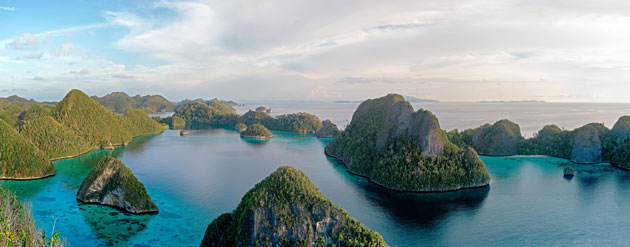
A stunning exhibition featuring images from some of the world's finest nature and wildlife photographers is from Thrive! which took place at London's Saatchi gallery over the weekend. The exhibition organised by BG Group and Conservation International aims to showcase examples of nature's beauty and fragility, but to underscore how human wellbeing and the natural world are inextricably linked
Visit this for more pics and details
http://www.guardian.co.uk/environment/gallery/2009/sep/21/thrive-wildlife-photography
Wednesday, January 20, 2010
The Bermuda Triangle: Facts and Theories

The Bermuda triangle is one of the most mysterious and dangerous areas of the earth’s oceans, responsible, or blamed, for the disappearance of over 2,000 vessels and 75 airplanes through a rather short period of three centuries.
The Triangle is an area of the Atlantic Ocean whose size varies by the author who happens to be writing about it; although its most common points are San Juan, Puerto Rico; Miami, Florida; and the island of Bermuda. It gains its fame from the large amount of ships and planes that have vanished without a trace within the last century.
The first known documentation of strange anomalies in the Bermuda Triangle was recorded by the famed explorer Christopher Columbus in October 1492, when he and his crew was said to have passed through the area. On the eleventh of October of that year, Columbus recorded in his log book that his crew had seen “strange dancing lights on the horizon”, “flames in the sky”, and later recorded that he had observed bizarre compass bearings in the area.
This was the first known recording of any strange occurrences in the triangle leading to the discovery of the New World in 1492, but it was not the last. After the discovery by Spain and Portugal that the New World could be a source of valuable minerals and abundant resources, the countries sent galleons to transport the materials from the New World back to Europe.
It was recorded that many of these vessels, loaded with gold stolen from the North American natives, disappeared without a trace throughout the Atlantic and the Caribbean]. Some of these galleons have been recovered within the last century by modern researchers and salvage experts who have analyzed the ocean bottom-but the nature of their disappearances is yet to be explained with certainty.
The term “Bermuda Triangle” was popularized in a 1964 issue of Argosy Magazine by Vincent Gaddis; and in 1974 it largely achieved its fame through the publication of The Bermuda Triangle by Charles Berlitz. The book recounts the disappearances of many aircraft and ships, in particular, the loss of five U.S. Navy Avenger torpedo bombers in 1945, known as Flight 19.
Perhaps the most famous disappearance in the Triangle was that of Flight 19. The Saga began on December 15th, 1945 when five Avenger torpedo bombers lifted off from the Navel Air Station at Fort Lauderdale. The flight was meant to be a practice bombing run for thirteen students and a Commander, Lt. Charles Taylor. About an hour and a half into the flight had left; a transmission was picked up by Taylor. He indicated that his compasses were not behaving properly, but he believed himself to be over the Florida Keys (islands south of the Florida mainland).
The flight coordinator urged him to fly north toward Miami if he was sure of his location to the south of Florida. Due to the lack of global positioning technology or other location-tracking devices, Taylor had to rely on the compass; and since it was acting strangely, he became confused as to his real location.
Taylor began flying northeast toward where he thought was the Naval Air Station, but he never returned in time, which brought speculation that he may have flown off course-to the northeast of Florida. The communications between Flight 19 and the mainland weakened, and as time went on, snatches of transmissions were received indicating that the other flight 19 pilots-the students-were attempting to persuade Taylor to change course.
“If we could just fly west”, one of the students said to another, “we are sure to get home.” He was right, because at 5:50 P.M. that day, the Com Gulf Sea Frontier Evaluation Center managed to get a fix on Flight 19’s weakening signals. They were apparently east of New Smyrna Beach, Florida, but the communications were so poor that this information could not be passed on to the lost planes.
Searches were made for the lost planes, but to no avail. A PBM Mariner plane with a thirteen-man crew was sent out to search for the fliers, and it too never returned. Many theories have arisen surrounding the disappearance, including the possible capture by extraterrestrials, government cover ups, and invisible time warps.
The most common, viable explanation is that the fliers, heading out to sea, eventually ran out of fuel and went down into the ocean; where the planes would sink and the pilots would drown-possibly eaten by sharks.
The loss of Flight 19 is indeed ponderous, but it does not remain unexplained. In fact, every disappearance can be explained in both a theoretical or paranormal sense; although some of these explanations are not adequate enough to be accepted as a fact. One such disappearance is that of the U.S.S. Cyclops in March 1918. The ship vanished with 10, 800 tons of manganese and 309 men on board while en route from Barbados to Baltimore.
Theories of this disappearance ranged from mutiny at sea to a large boiler explosion which prevented any distress call. One magazine, the Literary Digest, speculated that a giant octopus rose from the sea, entwined the ship with its tentacles, and dragged it to the bottom.
These and many other disappearances are always accompanied by explanations, many of which have been accepted as facts, but most are merely theories. The factual explanations; the explanations that researchers know for certain can cause a plane or seagoing vessel to disappear, or simply get lost-are volatile weather, methane gas bubbles from the sea floor, piracy, and compass variations.
To start with the most obvious explanation, volatile weather will be discussed. As known by most people, the Bermuda Triangle area is the source of many of the hurricanes that ravage the southeastern coast of the United States from year to year. These are extremely dangerous storms which many seamen take for granted. Many a fishing vessel has either been sent to the ocean bottom or has been found run aground on a remote beach due to the effects of a recent storm because of their captain’s disregard for safety. Hurricanes and other storms can cause dangerous ocean waves that can overturn and sink any vessel, small or large-in hours or even minutes.
Due to the rapid temperature variations in the triangle, some of these weather conditions can occur quickly, without any warning, and cause the sinking of a vessel overnight. On the next morning, the rescue crew sent out would find no remains and no evidence as to what happened, because the storm had quickly faded.
Due to these sudden weather occurrences, the Coast Guard answers about 8,000 distress calls a year; or twenty-three a day-although most of these problems could have been avoided if caution had been used. And many of these weather conditions are electrical/thunder storms, which can disrupt communications between the vessels and the shore. The communications of planes are also effected.
What about methane gas? How in the world can methane gas on the sea floor lead to the disappearance of ships and planes? It’s possible. Researchers say that the high pressures of ocean water in the area lead to the decomposition of organic materials into methane gas which, after a sufficient amount is built up, rises to the surface. Because methane gas is a gas it displaces the water around it, decreasing its density.
A vessel floating above would feel a downward lurch when the disturbance reached the surface, similar to that of an elevator. This would happen because the seawater was not dense enough to allow the ship to remain buoyant. Depending on the size of the bubble, the ship or small vessel would fall down a meter or two, then rise back up; or descend far enough so that water could spill onto the deck and sink the ship. After the gas reaches the surface, it disperses in the air, where it can cause the engine failure of a plane.
What about pirates? When people think of pirates, they immediately recall a book or a movie such as Pirates of the Caribbean, where the setting is in the 1700-1800’s when the world’s oceans were a free for all. A time when these mean, nasty people could overtake someone’s vessel during the night, strip it of all its valuables and possibly kill the people onboard, then leave without ever seeing any justice.
Many people refuse to believe it, but it continues to happen, even today in our modernized world where justice is properly served. Throughout the century many vessels have been found abandoned in the Bermuda Triangle. There is the possibility of a group of armed men overtaking a vessel overnight, robbing it of valuables, murdering the people on board; and leaving without providing any evidence for the authorities to find when they recovered the abandoned vessel.
Compass variations have caused many of the disappearances of ships and planes, but this problem is now being overcome through the use of modern technology, such as Global Positioning System (GPS).
Many paranormal theories have been proposed to explain the mystery of the Triangle. Theorists, researchers, and even respected scientists have supported claims that the Triangle is an area under frequent visits by UFO’s, where time warps threaten to send people into another dimension, where still active Atlantis technology buried on the sea floor vaporizes ships and planes in a matter of seconds; and where sea monsters grasp ships in their tentacles and pull them under.
Many theoretical physicists support the theory that tiny wormholes pop in and out of existence in the open air, unseen to the naked eye; and somehow paranormal theorists have linked the disappearances in the Triangle to this. If such anomalies did exist, they would likely be too small to cause the disappearance of a giant tanker or an airplane.
There is much support for the theory that UFO’s and extraterrestrials are responsible for the many losses in the Triangle. Seamen have reported sightings of “strange flying aircraft” and immediately claimed that they were occupied by ET’s, and when they reach the media, the story spreads-though it may not be true. Before long, the idea spreads that the missing people may have been abducted. This had become popular in the mid-1950’s; around the time of the testing of many experimental government aircraft. When sightings of one of these aircraft occurred, civilians would notify the Tabloids that an UFO have passed over their house, and even provide a photo that they had taken.
This is just an overview of the mystery of the Bermuda Triangle, it is not meant to persuade anyone to believe differently about the theories surrounding the mystery; although from the information above the reader might arrive at an opinion. The triangle in many aspects is a very fascinating place, and with deeper understanding the people can find the answer that solves the mystery altogether.
Is the triangle inhabited by aliens that randomly snatch planes and ships-and perform bizarre experiments on the occupants? Is their some powerful Atlantean Death Ray beneath the ocean that vaporizes ships and planes and leaves no trace of their disappearance? Maybe modern day pirates, or extreme weather, like hurricanes; is responsible. That… And all else, is to be determined by the reader.
Let the mind wonder… Just not too much.
Subscribe to:
Posts (Atom)